


TRACEABILITY
Nano Challa is one of Ethiopia’s most respected and prestigious coffee cooperatives, renowned for producing exceptional Ethiopian washed coffee. Established in 2004 by just 25 smallholder farmers, the cooperative has grown into a thriving community with over 600 members and two modern washing stations.
Situated in the Gera district of the Jimma region, Nano Challa’s coffee farms span 2 to 3 hectares and are deeply embedded in vast areas of indigenous forest. These forest-grown coffee plots are naturally shaded by wild coffee trees and host an unknown number of indigenous Ethiopian coffee varieties, carefully selected and preserved over generations. Beyond coffee, the Gera forest is also celebrated for its high-quality forest honey, contributing to the region’s rich biodiversity.
A major milestone came in 2010, when Nano Challa invested in its first Penagos 500 pulping machine, supported by a loan from the NGO TechnoServe. This marked the cooperative’s first production of washed Arabica coffee. Within just one year, the cooperative fully repaid the loan thanks to the high premiums earned for its outstanding coffee quality. Encouraged by this success, Nano Challa installed a second Penagos pulper in 2014, significantly increasing production capacity. Today, the cooperative remains free of long-term debt, sustained by consistently strong market prices and growing farmer participation.
At harvest, coffee cherries are hand-sorted upon arrival at the washing station to ensure quality. The cherries are then mechanically pulped and transferred to fermentation tanks, where natural yeasts and bacteria break down the remaining mucilage over 40–50 hours. After fermentation, the coffee is washed in concrete channels, allowing gravity to separate high-density beans from lower-quality ones.
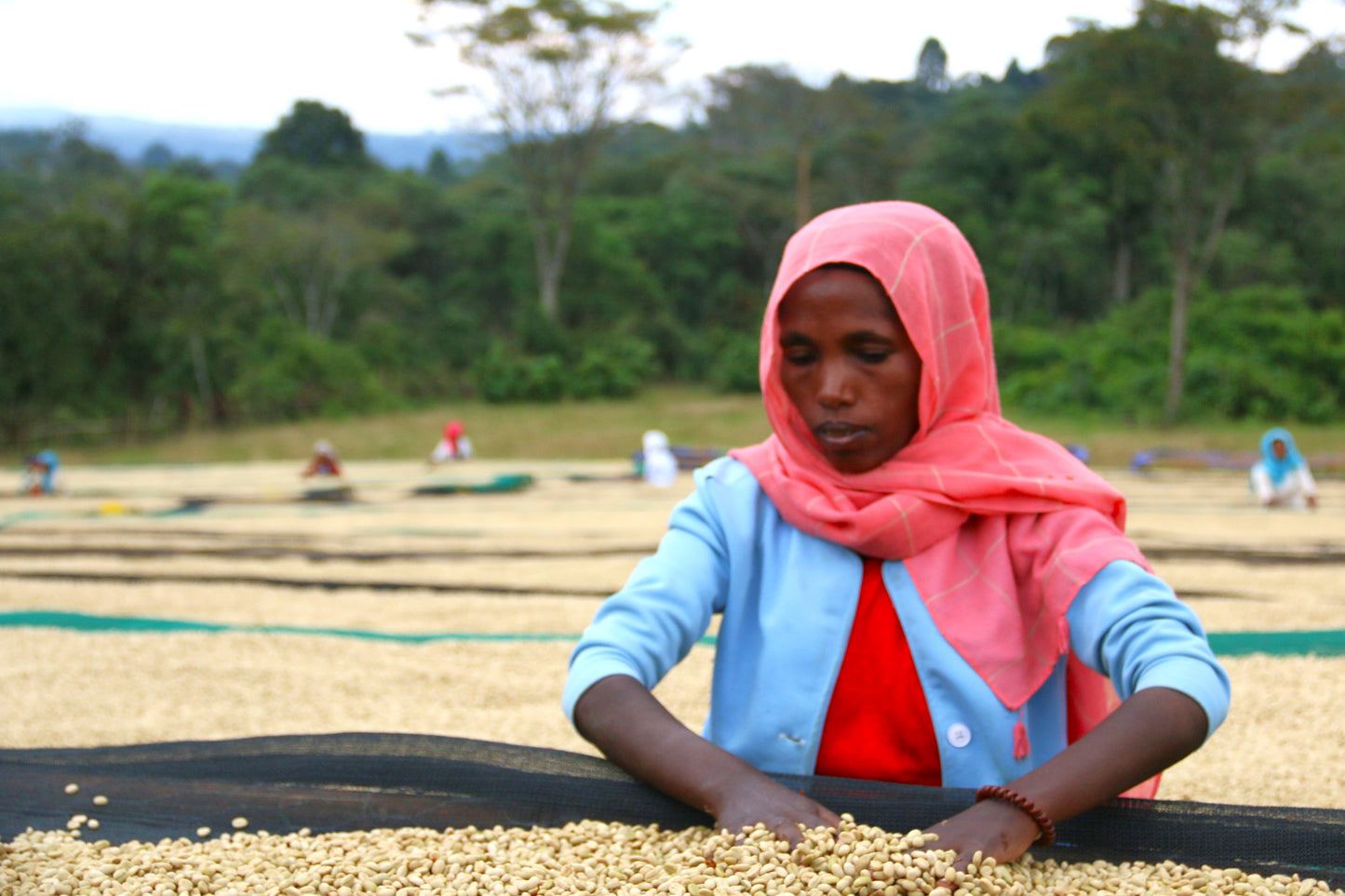
The clean parchment coffee is first dried on shaded drying beds, where additional manual sorting removes any immature or damaged beans while the parchment is still wet. After 24 hours, the coffee is moved to traditional African raised beds under the sun, drying slowly over 10–14 days until it reaches an optimal 11% moisture content.
- Choosing a selection results in a full page refresh.
- Opens in a new window.